Total market value for security printing reached $33.9 billion in 2026, according to Smithers, the leading global authority on the security print industry.
Data in its newly published report,
The Future of Global Security Printing to 2030, reveal that the market is growing at a 3.2% compound annual growth rate (CAGR) to reach $39.7 billion in 2030, driven by technology upgrading, system integration, and the convergence of physical and digital security layers.
The report points to recent global instability as a key factor in exposing fragilities across supply chains. Critical materials such as polycarbonate and optical films have become harder to source, while emergency currency programmes in Argentina and Zimbabwe have underscored the enduring strategic importance of physical cash. These pressures are accelerating investment in geographically diversified supply networks and digital identity programmes as governments seek more agile tools for crisis response.
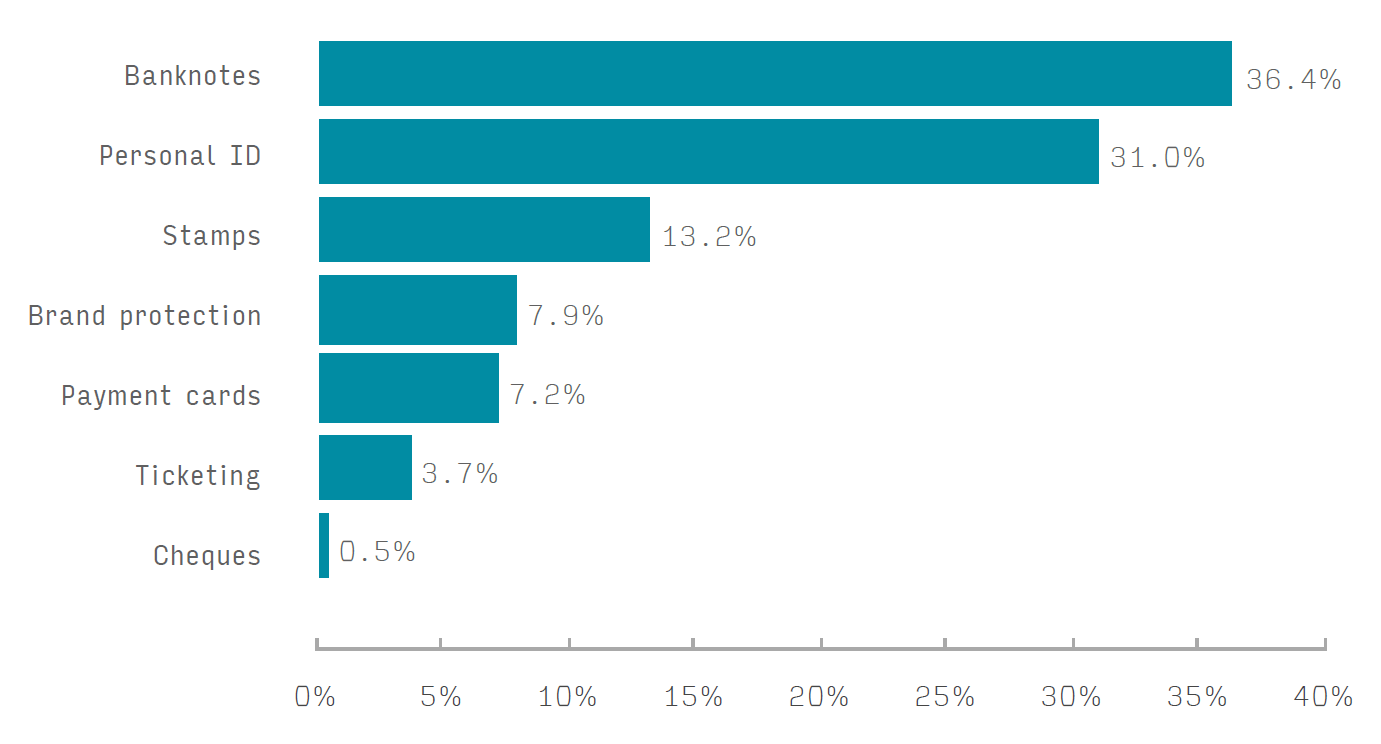
Banknotes represent the largest sector at 31.4% market share. While cash is used less frequently in everyday transactions across advanced economies, the total value in circulation has remained resilient. The global banknote printing market is projected to grow at a 2.7% CAGR to reach $14.1 billion by 2030 – a shift from volume-driven to value-led growth, with production increasingly characterised by fewer but more technically sophisticated runs.
Personal ID documents, the second largest sector at 31%, represent the most stable and structurally resilient segment. Consistent growth of 2.9% CAGR to 2030 is supported by expanding national ID programmes, e-passports, and migration-related documentation. This segment benefits from higher security specifications and longer document lifecycles.
Tax stamps and brand protection represent the strongest growth vector – growing at 5.4% and 6.0% CAGR respectively – as traceability mandates expand globally, and governments strengthen revenue protection and anti-illicit trade measures.
Growth in payment cards remains steady but is losing momentum, reflecting a maturing market increasingly challenged by the rise of digital wallets. This sector will shift towards premium materials and high-value personalisation as digital provisioning becomes a core revenue stream.
Structural decline is evident in cheques and ticketing. Cheques experience sustained contraction throughout the forecast period, driven by digitisation of payments. Ticketing has shifted into decline post-2024, reflecting the migration to electronic and mobile ticketing platforms.
The report concludes that competitive advantage will increasingly favour providers capable of orchestrating end-to-end trust infrastructures, with the industry’s future defined less by print volume and more by its foundational role in national and international trust, compliance, and enforcement.
FIGURE 1: Global security printing market, by end-use sector (% value), 2025
 Source: Smithers
The Future of Global Security Printing to 2030
Source: Smithers
The Future of Global Security Printing to 2030 assesses the impact of geopolitical, technological, economic, and regulatory driving forces on market evolution through the end of the decade. Based on extensive primary research, the report segments the market by security technology, end-use application and geographic region, and forecasts growth from 2025 to 2030.
The report is available to purchase now from Smithers priced $6,750 (€6.350, £5,475).