New research from Smithers, the global authority on the printing industry, tracks the global inkjet market. According to its latest market study,
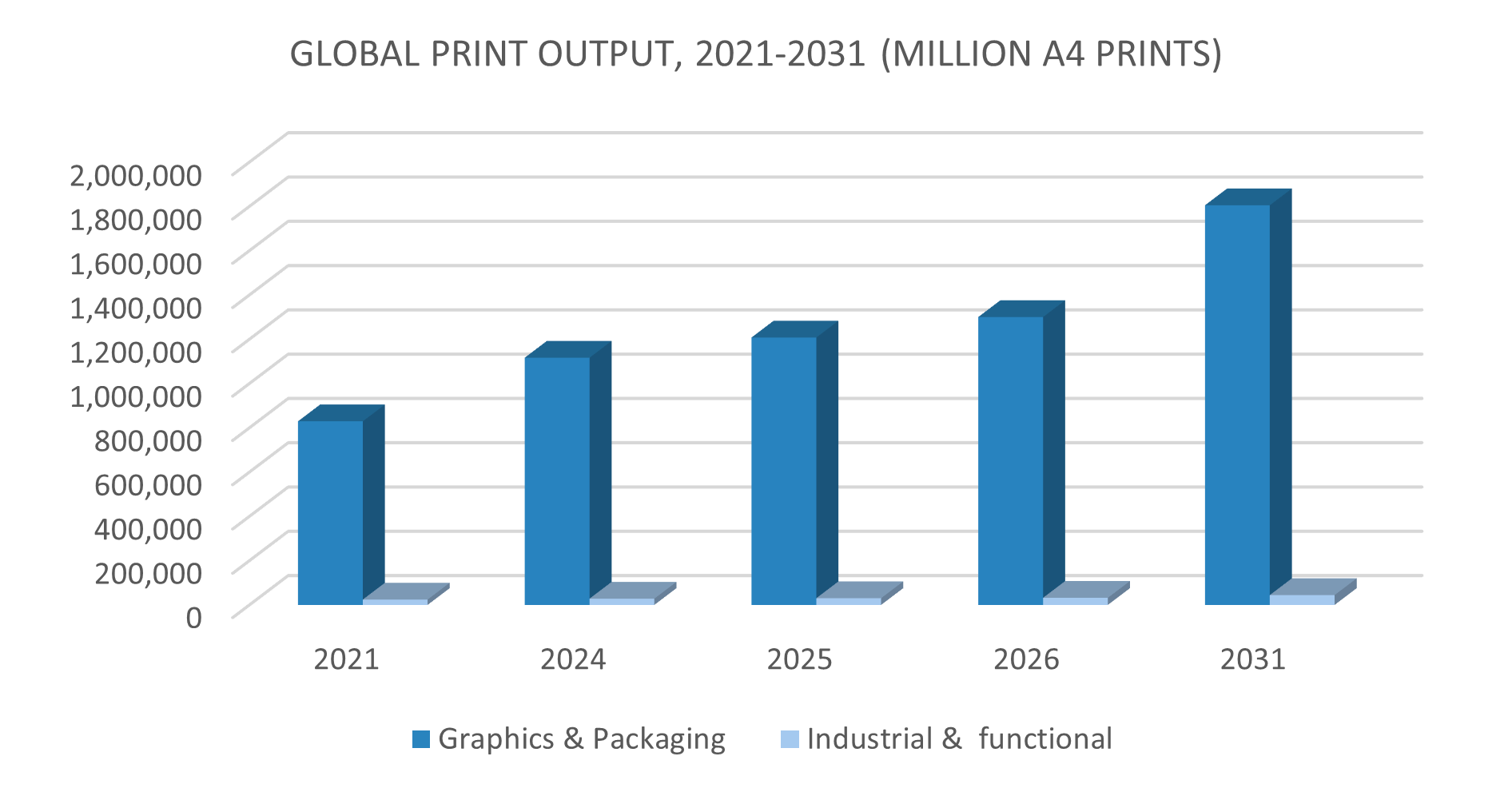
The Future of Inkjet Printing to 2031, strong growth between 2021 and 2025 is followed by strong albeit lower growth in the five years to 2031.
The graphic and packaging inkjet market is valued at $101.1 billion in 2026, with output growing at 9.4% CAGR and 6.9% CAGR in value and volume respectively. The functional and industrial market, while smaller, adds a further $29.2 billion in 2026. Growth is forecast to continue across both segments, with graphic and packaging inkjet reaching $134.6 billion by 2031 and the industrial and functional sector valued at $42.7 billion, driven by structural shifts in geography, application mix, ink chemistry, equipment design and operational technology.
Asia Pacific is emerging as the dominant force in global inkjet, the research shows, drawing level with North America in volume by 2026 and overtaking it across all metrics by 2031. China and India are at the centre of this shift, not only as major consumer markets but as increasingly competitive producers of inkjet hardware and consumables. Western equipment manufacturers are facing a new competitive landscape as a result.
Within end-use segments, the report finds packaging and labels are posting the highest growth rates as e-commerce, population growth and demand for short-run personalised print drive investment. Books and labels are among the fastest-growing applications, while advertising print and transactional output continue to decline. The resilience of packaging during the Covid-19 pandemic underlined its importance as a growth anchor for the wider industry.
Sustainability is reshaping the $9.9 billion ink market, the research shows. Water-based formulations are gaining ground across segments including textile, corrugated and commercial print, and are advancing rapidly into packaging where food-contact migration regulations and recyclability requirements are accelerating the transition away from solvent-based alternatives. Print-on-demand capability is also positioning inkjet as a tool for reducing overproduction and inventory waste.
Equipment development is moving decisively towards purpose-optimised machines. Rather than general-purpose platforms, manufacturers are developing presses engineered for specific applications, with proprietary print head technology increasingly central to that strategy. The result is fewer units sold but higher productivity per machine, a trend already visible in wide-format graphics where older, lower-output devices are being consolidated.
AI and automation are closing the cost gap between inkjet and analogue production. Predictive maintenance, AI-driven diagnostics, inline inspection and fleet management software are extending uptime, reducing waste and improving total cost of ownership. Generative AI is also entering the origination workflow, enabling unique imagery to be produced at commercial scale. By 2031, these capabilities are expected to be standard across the installed base.
Global Print Output
 Source: Smithers
The Future of Inkjet Printing to 2031
Source: Smithers
The Future of Inkjet Printing to 2031 provides comprehensive market sizing, segmentation, and forecasts by end-use market, graphics & packaging ink, inkjet equipment and geography, alongside in-depth analysis of the regulatory, competitive, and technological forces reshaping the industry.
The report is available to purchase now from Smithers priced $6,750 (€6.350, £5,475).