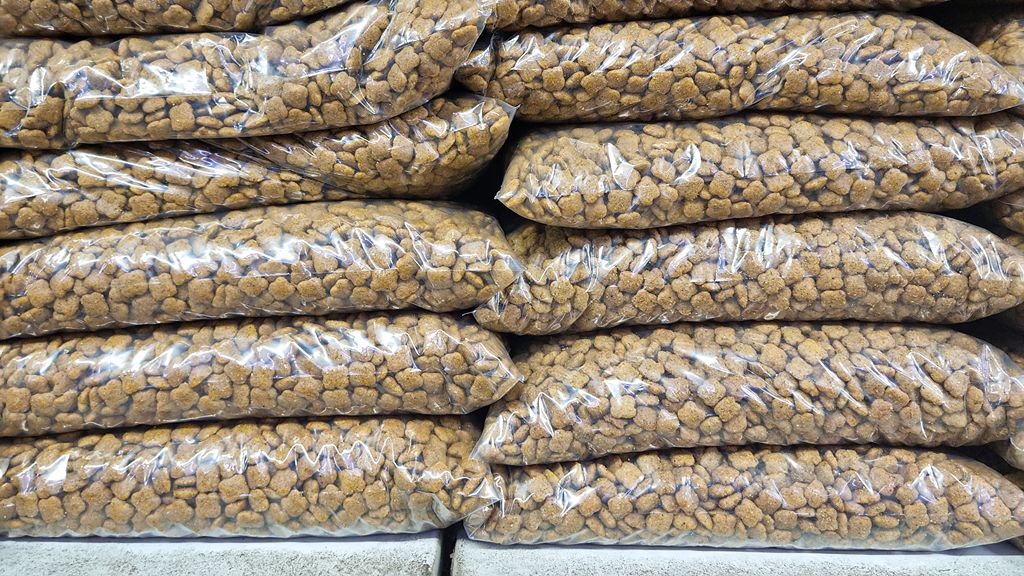
Every bag of dry pet food takes a long journey before your pet ever sees it. Between the packaging line and the retail shelf, kibble is stacked, vibrated on truck beds, dropped during handling, and compressed under the weight of the packages above it. By the time the bag is opened, a portion of what started as uniform, well-formed kibble has broken down into smaller pieces, dust, and fines.
For manufacturers, that breakdown is more than cosmetic. Fines change how the product looks in the bag, how it smells, and how consumers perceive quality. The good news is that kibble breakage is measurable, repeatable, and can be traceable back to specific formulation and packaging decisions. The key is testing that reflects the real journey rather than a bench-top approximation of it.
This short article from Technical Director, Mike Kuebler, discusses the factors involved in dry pet food breakage and the testing we can employ to help you get to the bottom of the issue.
Why kibble breaks before it reaches the bowl
Fines are not created at a single moment. They accumulate at every point where kibble is handled, and the supply chain adds the final, and often harshest, layer of stress. Distribution through the supply chain introduces three primary hazards:
- Vibration from long stretches of over-the-road transport, which drives constant abrasion inside the bag.
- Shock from drops during loading, unloading, and manual handling.
- Compression from stacking, where a bag at the bottom of a pallet carries the full load above it.
How well a given product resists those forces depends on factors such as product formulation, shape, and processing. Kibble shape, starch source, degree of gelatinization, density, and porosity all influence how much force a piece can absorb before it fractures. A more intricate shape with thin points can concentrate stress and tends to shed fines more readily than a simple, compact form. Each variable can present challenges for the durability of the kibble, which is why understanding performance through laboratory testing can help food scientists and packaging engineers get to the root cause of breakage sooner.
Measuring what actually happens: distribution simulation plus sieve analysis
Designing a testing program that most closely aligns with the actual supply chain can be challenging. There are certainly ways to vibrate or cause abrasion with kibble that could replicate a breakdown in the structure. But, choosing testing protocols that have been specifically designed to mirror actual handling and transit is critical. A more representative method pairs two steps.
First, the packaged product is run through a recognized distribution profile, such as an
ISTA procedure, that sequences vibration, shock, and compression to mirror the real supply chain. This tests the product and the package together, as a system, in the configuration that is actually transported and stored.
Second, the tested product is separated using a Ro-Tap™ sieve stack. By capturing how much material falls into each mesh size, the analysis produces a particle size distribution: a precise before-and-after picture of how the kibble changed during simulated transit. Instead of a single pass-or-fail number, food scientists receive a full profile showing not just how much broke, but how it broke and into what mesh sizes.
That distribution is the data set that makes targeted improvement possible.
Turning the data into formulation decisions
A particle size distribution can potentially tell a formulation team where the product is failing and gives them options to correct the issue:
- Shape and geometry. If a complex or thin-walled shape is generating disproportionate fines, redesigning to a more robust profile can reduce breakage without changing the recipe.
- Starch source and content. Starch drives cohesion and structural integrity. Too little and the kibble crumbles. The type of starch used influences how resistant a piece may be to fracturing. Adjusting the starch source is a common response when breakage rises on an otherwise stable formula.
- Process conditions. Extrusion temperature, moisture, and specific mechanical energy all shape density and durability. Small process shifts can meaningfully change how a kibble holds up, and testing quantifies the payoff of each change.
Because the sieve data is repeatable, teams can test a formulation change, rerun the distribution profile, and confirm whether the fines fraction actually improved.
Turning the data into packaging decisions
Not every fix belongs in the recipe. Sometimes the more efficient path is to protect a good product better. Distribution testing also informs packaging choices:
- Film structure. Sharp kibble edges and compression during shipping stress the bag itself. Tougher, puncture-resistant film structures reduce both bag failures and internal abrasion.
- Fill level and headspace. How much the bag is filled affects how much the product can shift and grind against itself during vibration.
- Bag and pallet configuration. Coefficient of friction, bag stiffness, degassing valves, and pallet stacking patterns can all influence how loads settle and how much movement the product experiences in transit.
Testing lets a manufacturer compare configurations directly and choose the one that delivers the least breakage for the cost.
From guesswork to evidence
The difference between reacting to consumer complaints and reducing or preventing them is data. A distribution simulation paired with sieve analysis replaces assumptions about what happens in transit with a measured particle size distribution that formulation and packaging teams can act on with confidence. It shows where the product is potentially vulnerable, quantifies the benefit of each proposed change, and validates the final result before it ships at scale.
Frequently asked questions
Why does kibble break during shipping?
Kibble is subjected to vibration, drop shock, and compression as it moves through the supply chain. Combined with the product's shape, starch composition, and density, these forces cause pieces to abrade and fracture into smaller pieces, dust, and fines.
What is a Ro-Tap™ sieve analysis for kibble?
It is a method that passes a tested sample through a stack of graduated mesh screens to sort the material by size. The resulting particle size distribution shows exactly how much kibble broke down and into which size fractions.
Can testing fix kibble breakage, or does the recipe have to change?
Testing identifies the potential problem and points to possible fixes, which may be a formulation change, a packaging change, or both. The data lets a manufacturer weigh each option and validate the result before full production.
Why do fines at the bottom of the bag matter?
Fines affect product appearance, can settle visibly in the package, and oxidize faster than whole kibble because of their larger surface area, which can lead to freshness and palatability complaints.