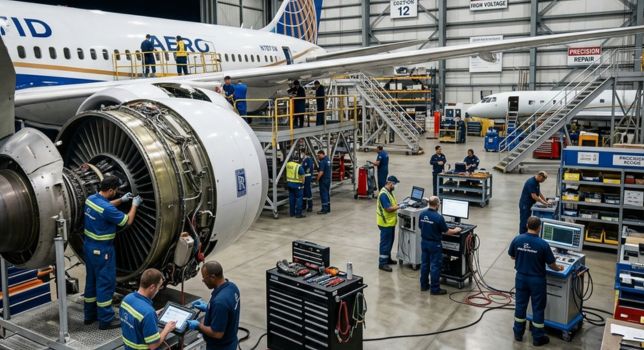
Quick Answer: AS9110 is the globally recognized quality management standard for aviation MRO organizations. By embedding disciplined process control, traceability, risk-based thinking, and continual improvement into daily maintenance operations, AS9110 transforms hangar-floor discipline into measurable safety outcomes—making it far more than a compliance credential.
Commercial aviation has achieved extraordinary safety gains over the past decade. According to IATA's 2025 Annual Safety Report, the rate of fatal accidents has dropped from one per 3.5 million flights (2012–2016 average) to one per 5.6 million flights (2021–2025 average). That improvement didn't happen by accident. It is the product of relentless standardization, rigorous oversight, and a global commitment to learning from every near-miss and nonconformance.
Aircraft maintenance sits at the center of that effort. Every flight depends on the precision and reliability of the work performed before wheels leave the runway. Yet the research consistently flags maintenance environments as high-risk: human factors contribute to an estimated 70–80% of all aviation accidents and incidents, according to data cited by the National Academies of Sciences, Engineering, and Medicine and corroborated across aviation safety literature. The margin for error is essentially zero.
AS9110 addresses that reality directly. Developed by the International Aerospace Quality Group (IAQG) and built on the ISO 9001:2015 framework, AS9110 establishes rigorous quality management system (QMS) requirements specifically designed for organizations performing maintenance, repair, and overhaul (MRO) activities on civil and military aircraft. The current version—AS9110 Revision C—goes well beyond generic quality principles, layering in aerospace-specific requirements that map directly onto the conditions where maintenance errors are most likely to occur.
What Does AS9110 Require, and Why Does It Matter for Safety?
AS9110 is not a checklist. It is a structured management framework that demands organizations demonstrate, through documented evidence and independent audit, that their processes are controlled, their people are competent, and their systems are set up to catch errors before they affect airworthy equipment.
The standard's requirements span organizational leadership, risk planning, maintenance process control, technical data management, supplier oversight, configuration management, and continual improvement. For aviation safety, several of these areas carry particular weight.
How Does AS9110's Configuration Management Requirement Reduce Maintenance Errors?
Configuration management is among AS9110's most operationally significant requirements. It demands that MRO organizations maintain accurate traceability of aircraft, components, and associated documentation throughout every stage of the maintenance cycle.
In practice, this means every part installed on an aircraft must be traceable—its origin, its service history, and its conformity status documented and verifiable. When configuration management breaks down in maintenance environments, the consequences can be severe: incorrect parts installed, modifications applied to the wrong revision of an aircraft, or undocumented changes that compromise airworthiness. AS9110 closes these gaps by making traceability a non-negotiable process requirement rather than an administrative afterthought.
How Does AS9110 Address Human Factors in Maintenance Operations?
Human error in aviation maintenance is not primarily a training problem. More often, it stems from unclear procedures, inadequate task handover, time pressure, and fatigue—conditions that even experienced technicians cannot fully compensate for through individual skill alone. AS9110 Revision C explicitly addresses human factors as a systemic concern.
The standard requires organizations to establish clear maintenance procedures, assess and document personnel competency, and build structures that support consistent task execution regardless of shift patterns or individual variation. By treating human performance as a process variable—something to be managed and improved—rather than a fixed input, AS9110-compliant organizations create maintenance environments that are structurally more resistant to error.
What Role Does Risk-Based Thinking Play Under AS9110?
AS9110 Revision C places explicit emphasis on risk-based thinking, requiring organizations to identify, assess, and mitigate operational risks systematically. This includes analyzing safety hazards in maintenance activities, implementing preventive measures, and monitoring the effectiveness of those measures over time.
The practical benefit is a shift from reactive to proactive safety management. Rather than waiting for an incident to reveal a weakness, AS9110-certified MRO organizations are required to anticipate where failures could occur and act before they do. This aligns closely with the approaches recommended by the FAA and EASA—and it is part of why AS9110 maps so naturally onto FAA Part 145 and EASA Part-145 repair station requirements.
How Does Continual Improvement Under AS9110 Translate to Safer Aircraft?
One of the most under-appreciated aspects of AS9110 is its continual improvement mandate. Certification is not a one-time achievement. AS9110-certified organizations must conduct regular internal audits, undergo annual surveillance audits by their accredited certification body, and submit to full recertification every three years.
This cycle of ongoing evaluation creates a structured feedback loop. Non-conformances identified during audits must be addressed through documented corrective actions. Performance data must be analyzed to identify trends. Each cycle of review is an opportunity to close gaps, refine procedures, and raise the quality floor across the entire maintenance operation.
IATA's data illustrates the broader value of this kind of standards-driven improvement. Airlines registered on IATA's Operational Safety Audit (IOSA) program recorded an all-accident rate of 0.98 per million flights in 2025—significantly lower than the 2.55 recorded by non-IOSA carriers. The principle is consistent: structured quality standards, rigorously applied and independently verified, produce measurable safety outcomes.
What Does AS9110 Certification Signal to Customers and Regulators?
AS9110 certification is not a legal requirement under FAA or EASA regulations. However, its strategic weight within the industry is substantial. Major airlines, original equipment manufacturers (OEMs), and defense contractors increasingly mandate AS9110 certification as a prerequisite for MRO contracts. Organizations without it frequently find themselves excluded from competitive bids before evaluation even begins.
Beyond market access, certification provides a credible, independently verified signal that an MRO organization has the processes, controls, and accountability structures required to deliver safe, compliant maintenance consistently. For customers entrusting their aircraft to an MRO provider, that assurance carries real operational significance.
Regulatory alignment is another concrete benefit. Because AS9110's framework maps closely to FAA Part 145 and EASA Part-145 requirements, organizations that implement AS9110 often find the path to regulatory approval smoother as a result. The standard does not replace regulatory compliance—it reinforces the organizational discipline that makes compliance achievable and sustainable.
AS9110 as a Strategic Foundation, Not a Compliance Checkbox
The most important reframe for MRO leaders considering AS9110 is this: certification is not the goal. Safer, more reliable maintenance operations are the goal—and AS9110 provides the management architecture to achieve them.
Organizations that pursue AS9110 purely to satisfy a contractual requirement will implement it differently than those that understand its safety logic. The former may achieve certification; the latter build organizations that are genuinely harder to fail. Configuration management disciplines that prevent incorrect parts from reaching aircraft. Human factor requirements that reduce the conditions under which technicians make errors. Risk-based processes that surface hazards before they become incidents. Continual improvement cycles that raise the quality floor year after year.
That is what AS9110 looks like when it works as intended—not a set of boxes to check before an audit, but a living management system that connects hangar-floor discipline to the safety of every passenger who boards an aircraft maintained by a certified organization.
The Path From Standard to Safer Skies
Commercial aviation's safety record represents one of the most significant engineering and management achievements of the modern era. The trajectory is encouraging: IATA's Director General Willie Walsh noted in the 2025 Safety Report that "flying is the safest form of long-distance travel," while calling for continued focus on continuous improvement through global standards.
AS9110 is one of those global standards. For MRO organizations committed to operating at the highest level of quality and safety, it offers a proven framework—one grounded in the specific realities of aviation maintenance, independently audited, and globally recognized. Starting with a thorough gap analysis, building a compliant QMS, and partnering with an IAQG-accredited certification body gives any MRO organization a clear and achievable route to certification—and to the safety outcomes that certification is designed to support.
Take the next step toward AS9110 certification by requesting a personalized quote or contacting us today to discuss how we can support your organization’s commitment to safety and excellence.
Frequently Asked Questions About AS9110 and Aviation Safety
What is AS9110, and what types of organizations need it?
AS9110 is an internationally recognized quality management standard developed by the International Aerospace Quality Group (IAQG) for organizations that perform maintenance, repair, and overhaul (MRO) activities on civil and military aircraft. It applies to independent aircraft maintenance facilities, airline maintenance divisions, component repair shops, overhaul stations, and organizations managing continuing airworthiness. AS9110 is distinct from AS9100, which applies to aerospace manufacturers, and AS9120, which applies to distributors.
Is AS9110 certification required by the FAA or EASA?
AS9110 certification is not a direct legal requirement under FAA or EASA regulations. However, many airlines, OEMs, and defense contractors require it contractually as a condition of doing business. Because AS9110's framework maps closely onto FAA Part 145 and EASA Part-145 repair station requirements, certification also tends to streamline the path to regulatory approval.
How does AS9110 specifically improve aviation safety outcomes?
AS9110 improves aviation safety by requiring MRO organizations to implement controlled maintenance processes, manage traceability of parts and documentation, address human factors systematically, apply risk-based thinking to operational hazards, and continuously improve their quality management systems through regular audits and corrective actions. These requirements target the conditions under which maintenance errors most commonly occur.
How long does AS9110 certification last, and what are the ongoing requirements?
An AS9110 certificate is valid for three years. Certification bodies conduct annual surveillance audits in years one and two to verify continued compliance. A full recertification audit is required at the three-year mark. Between audits, certified organizations are required to maintain internal audit programs, monitor performance data, and address non-conformances through documented corrective actions.
How does AS9110 differ from AS9100?
AS9100 applies to organizations that design and manufacture aerospace products. AS9110 is specifically designed for MRO organizations and includes requirements tailored to the maintenance environment—such as airworthiness documentation, configuration management of serviced aircraft, first article inspection, and human factors in maintenance tasks. Both standards are built on ISO 9001:2015, but AS9110 adds MRO-specific requirements that AS9100 does not include.
How long does it take to achieve AS9110 certification?
Most MRO organizations should plan for a preparation period of six to eighteen months before the certification audit, depending on the size and complexity of the organization and the current maturity of its quality management system. The process includes gap analysis, QMS development and documentation, employee training, internal audits, and a two-stage certification audit conducted by an IAQG-accredited certification body.

.jpg?ext=.jpg)