IATF 16949 News: 2025 Rules and 2026 Changes
Discover essential updates on IATF 16949. Understand how the 2025 Rules 6th Edition and the 2026 standard revision will influence quality management systems.

Quick Answer: IATF Global Oversight is revising IATF 16949 to produce a Second Edition, driven by stakeholder feedback. The update targets five priority areas: simplification, software quality assurance, supply chain management, launch management, and customer-specific requirements. Publication is planned for mid-2027, with transition aligned to ISO 9001.
In July 2026, IATF Global Oversight released Stakeholder Communiqué SC-2026-005—a formal announcement confirming that IATF 16949 Second Edition is actively in development. For automotive suppliers, certification bodies, and quality professionals, this is significant news.
IATF 16949 is the globally recognized quality management system standard for the automotive industry, built on the foundation of ISO 9001. Its requirements govern everything from supplier selection to product launches to software quality. A revision of this magnitude touches virtually every corner of the automotive supply chain.
So what's changing, why does it matter, and when does your organization need to act? Here's a clear, structured breakdown of everything you need to know.
The revision is stakeholder-driven. IATF Global Oversight gathered feedback from across the automotive industry and identified recurring pain points that the current standard does not adequately address. Rather than a wholesale rewrite, IATF 16949 Second Edition focuses on targeted improvements—areas where the standard can be made more effective, consistent, and easier to apply.
Five priority topics have been confirmed for Revision 2, each selected based on the frequency and urgency of stakeholder feedback.
One of the most common criticisms of IATF 16949 is that it can be difficult to interpret consistently. Auditors, suppliers, and OEMs often reach different conclusions from the same clause—creating variability that undermines the standard's value.
IATF 16949 Second Edition aims to reduce this ambiguity. The revision will streamline language, improve the clarity of existing requirements, and eliminate unnecessary overlap with ISO 9001. The goal is a standard that is easier to understand, implement, and audit without weakening its effectiveness.
Software has become inseparable from automotive products and manufacturing processes. Yet the current IATF 16949 framework was not designed with embedded software development as a central concern.
Revision 2 addresses this gap directly. IATF 16949 Second Edition will apply existing quality management principles consistently across the software life-cycle—covering development, validation, and integration. Importantly, the revision aims to improve software quality governance without introducing unnecessary complexity for organizations already managing software under separate frameworks.
Automotive quality failures rarely originate at Tier 1. More often, they trace back to lower-tier suppliers where customer requirements are poorly communicated, inconsistently applied, or not audited at all.
IATF 16949 Second Edition will strengthen the management of lower-tier (Tier N) suppliers through a more consistent, risk-based approach. This includes clearer deployment of customer requirements down the supply chain and improved communication between tiers. The result should be a more robust supply base with requirements that remain practical and auditable.
New product and process launches represent some of the highest-risk moments in the automotive life-cycle. Delays, quality escapes, and production disruptions during launch phases are costly—for suppliers, OEMs, and end customers.
Revision 2 will place greater emphasis on structured launch management. IATF 16949 Second Edition will promote a more disciplined approach to new product introductions, change management, and industrialization activities, with the explicit goal of improving launch readiness and reducing quality risk during implementation.
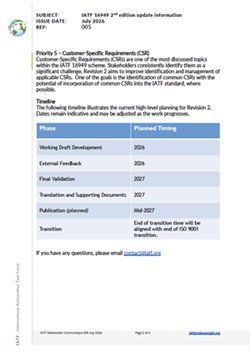
Customer-Specific Requirements are, by a wide margin, one of the most challenging aspects of IATF 16949 compliance. Each OEM maintains its own CSRs—and managing the differences across customers is a persistent burden for suppliers operating across multiple programs or regions.
Revision 2 takes direct aim at this challenge. IATF 16949 Second Edition will improve the identification and management of applicable CSRs. Where common CSRs exist across customers, there is a stated intent to incorporate these directly into the IATF standard—reducing fragmentation and easing the compliance burden for suppliers.
The following table outlines the current high-level planning timeline for IATF 16949 Second Edition, as confirmed by IATF Global Oversight in Communiqué SC-2026-005 (July 2026). Dates are indicative and subject to adjustment as the revision process progresses.
|
Phase |
Planned Timing |
|---|---|
|
Working Draft Development |
2026 |
|
External Feedback Period |
2026 |
|
Final Validation |
2027 |
|
Translation and Supporting Documents |
2027 |
|
Publication (planned) |
Mid-2027 |
|
End of Transition |
Aligned with ISO 9001 (End) |
Source: IATF Global Oversight Stakeholder Communiqué SC-2026-005, July 2026
A critical point for certification planning: the end of the IATF 16949 Second Edition transition period will be aligned with the end of the ISO 9001 transition. Organizations should factor this into their quality system roadmaps now, particularly those with certification renewal cycles falling in 2027 or 2028.
Publication is still roughly a year away, but proactive preparation makes a measurable difference when standards transitions occur. Based on the five priority areas confirmed for IATF 16949 Second Edition, organizations should consider the following steps:
At Smithers, our team of technical experts has deep experience with IATF 16949 requirements and understands the practical challenges of implementing standards across complex supply chains.
As IATF 16949 Second Edition moves from working draft to final publication, Smithers will continue to monitor developments and provide updated guidance for our clients. Whether your organization needs gap analysis support or certification advisory services, our team is ready to help you stay ahead of the transition.
Contact Smithers today to discuss how we can support your preparation for IATF 16949 Second Edition.
What is IATF 16949 Second Edition?
IATF 16949 Second Edition is the planned revision (Revision 2) of the current IATF 16949 automotive quality management system standard. It targets five priority areas: simplification, software quality assurance, Tier N supply chain management, launch management, and customer-specific requirements. Publication is planned for mid-2027.
When will IATF 16949 Second Edition be published?
According to IATF Global Oversight Stakeholder Communiqué SC-2026-005 (July 2026), publication is planned for mid-2027. Dates are indicative and may be adjusted as the revision progresses.
How long will the IATF 16949 Second Edition transition period be?
The end of transition for IATF 16949 Second Edition will be aligned with the end of the ISO 9001 transition. The specific transition duration has not yet been confirmed, but organizations should monitor IATF communications for updates.
What is driving the IATF 16949 Second Edition revision?
The revision is driven by stakeholder feedback collected from across the automotive industry. Key concerns include inconsistent interpretation of requirements, gaps in software quality governance, challenges with Tier N supplier management, launch risk, and the complexity of managing customer-specific requirements.
Can organizations participate in the IATF 16949 Second Edition development process?
Yes. An external feedback phase is planned for 2026. Organizations interested in contributing can engage through their certification bodies or monitor updates at iatfglobaloversight.org or by contacting IATF directly at contact@iatf.org.
What is the difference between IATF 16949 and ISO 9001?
IATF 16949 is an automotive-specific quality management system standard that builds on ISO 9001. IATF 16949 Second Edition is being developed to avoid duplication with ISO 9001 while strengthening automotive-specific requirements.