
Smithers to Present on Translational Biomarkers at ACT 2026
Translational biomarkers can strengthen preclinical toxicology data by providing additional insight into drug mechanisms, biological responses, and potential clinical relevance. Selecting the right biomarkers and planning bioanalytical strategies early can help sponsors generate more informative datasets and support drug development decisions.
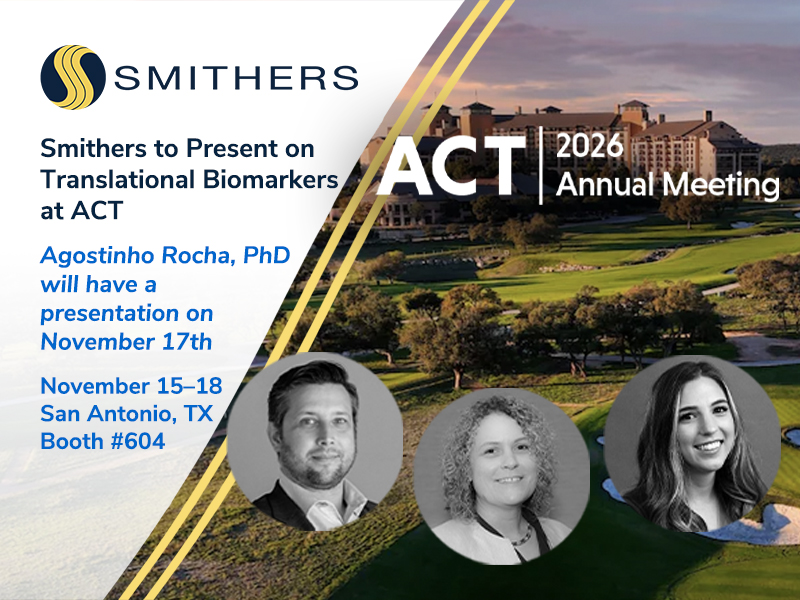
Smithers Pharmaceutical Development Services will attend the 47th Annual Meeting of the American College of Toxicology (ACT), November 15–18, 2026, at the JW Marriott Hill Country in San Antonio, Texas. Site Director Agostinho Rocha, PhD, Senior Director of Business Development Connie Scott, and Operations Manager Samantha Black will represent Smithers throughout the conference at Exhibit Booth #604.
On Tuesday, November 17, Agostinho will present Bridging Preclinical and Clinical Development: The Expanding Role of Translational Biomarkers. The exhibitor-hosted session will explore how toxicologists can use fit-for-purpose biomarkers to strengthen traditional preclinical endpoints and generate data that support clinical development.
Translational Biomarkers Strengthen Preclinical Toxicology Data
Traditional toxicology endpoints remain essential for evaluating drug safety. Additional biomarkers can provide insight into a compound’s mechanism of action, pharmacodynamic effects, and biological activity, helping sponsors better understand findings from preclinical studies.
Identifying biomarkers that can also be measured or interpreted in clinical studies is an important consideration during early drug development. Sponsors must evaluate which biomarkers provide meaningful information about the drug, how sensitive the analytical methods need to be, and whether the resulting data can support decisions as the program advances.
Early biomarker planning can also help sponsors identify opportunities to expand the information collected during toxicology studies. Integrating appropriate biomarkers with conventional endpoints can provide a more comprehensive view of a drug candidate’s biological effects.
For large-molecule programs, designing biomarker programs that scale from early development into clinical studies requires early consideration of assay performance, sample requirements, and the intended use of the data.
Fit-for-Purpose Biomarker Assay Development Requires Early Planning
Biomarker assay development begins with a clear understanding of the intended use of the data. The biological characteristics of the biomarker, its expected concentration, the sample matrix, and the study objectives all influence assay design.
Endogenous biomarker levels in animal models can affect assay development and interpretation. Sponsors must also consider analytical sensitivity, sample availability, and whether single-analyte or multiplex approaches are appropriate for the study.
Sample collection and handling require similar attention. Some biomarkers have limited stability or require specific processing conditions immediately after collection. Temperature, processing time, storage conditions, and collection time points can affect the quality of the resulting data.
These requirements should be established before a study begins. Early collaboration between bioanalytical scientists and toxicology study teams helps align assay requirements with study procedures, sample collection schedules, and available resources.
The appropriate assay development, qualification, or validation strategy depends on the intended use of the data. Sponsors can reduce avoidable challenges by addressing these requirements early, including during bioanalytical method development.
Sample Collection and Critical Reagents Can Affect Data Quality
A well-designed assay cannot compensate for samples that were collected or processed incorrectly. Bioanalytical scientists should review study schedules and collection procedures before study initiation to identify potential conflicts with assay requirements.
For example, an assay that requires immediate sample processing may not be compatible with a schedule that groups too many collection procedures into a limited time window. Coordinating sample collection, processing, and study activities helps ensure that specimens are handled appropriately and that planned assessments remain feasible.
Critical reagents also require careful consideration. Reagent characteristics, consistency, and availability can influence assay performance and reproducibility. Identifying potential limitations early allows the team to address them before they affect study execution or downstream analysis.
Sample volume is another important consideration. Sponsors should evaluate the amount of material each assessment requires rather than relying solely on established collection practices. Microsampling and other appropriate strategies may help conserve samples while supporting additional biomarker assessments.
For studies involving tissue samples, collection, processing, homogenization, and stability can introduce additional analytical challenges. Following best practices for biomarker assay validation in tissues can help sponsors account for these variables when planning preclinical assessments.
Retaining suitable samples for future exploratory analyses can also provide value. If an unexpected finding emerges during clinical development, archived preclinical samples may allow researchers to investigate potential biological explanations.
A Strong Bioanalytical Strategy Supports Better Development Decisions
Bioanalytical planning should be integrated into toxicology study design rather than treated as a separate activity after the protocol is established. Early collaboration helps align the scientific objectives, assay readiness, sample collection procedures, and analytical requirements.
Agostinho’s ACT presentation will include case studies illustrating how a well-planned bioanalytical strategy can strengthen drug development programs. These examples will address the importance of biologically relevant collection time points, assay readiness before sample collection, and procedures that preserve sample integrity.
The session will also examine how sponsors can make informed decisions about assay development, qualification, or validation based on the intended use of the data. The appropriate strategy depends on the scientific objectives and the decisions the resulting data must support.
Smithers works with sponsors to develop analytical approaches for complex biomarker endpoints, including assays involving blood, serum, plasma, and tissue samples. The scientific team evaluates the technical and operational requirements of each program to identify practical solutions for challenging analytical needs.
A science-first approach can be particularly important when conventional methods are insufficient for a complex endpoint. Understanding the biological question, available samples, assay limitations, and study logistics helps the team determine how to generate useful data within the requirements of the program.
Attend Smithers’ ACT 2026 Presentation on Translational Biomarkers
Agostinho Rocha, PhD, will present Bridging Preclinical and Clinical Development: The Expanding Role of Translational Biomarkers at ACT 2026.
Presentation details
Date: Tuesday, November 17, 2026
Time: 8:00–8:55 a.m.
Location: Grand Oaks Ballroom, Level 2, Suite S
The exhibitor-hosted session will address how fit-for-purpose biomarkers can strengthen datasets derived from traditional preclinical endpoints. Attendees will learn about selecting biomarkers that bridge preclinical and clinical development, developing practical assay strategies, planning sample collection, managing critical reagent considerations, and evaluating cost.
The presentation will emphasize the value of involving bioanalytical scientists early in study design. Attendees can expect practical insights into how assay readiness, sample handling, and collection schedules influence the reliability and usefulness of biomarker data.
Meet Smithers at ACT 2026
ACT attendees can connect with Agostinho Rocha, Connie Scott, and Samantha Black at Exhibit Booth #604 to discuss biomarker assay development, complex bioanalytical challenges, and scientific support for preclinical and clinical development programs.
Smithers works with biotechnology companies, pharmaceutical organizations, academic institutions, and government organizations to address program-specific scientific objectives, timelines, and analytical requirements. Each program presents different priorities, from meeting critical development milestones to resolving challenging analytical questions or developing assays for complex endpoints.
Early discussions can help identify the scientific and operational considerations that should inform a sponsor’s bioanalytical strategy.
Schedule a meeting with Smithers Pharmaceutical Development Services during ACT 2026 to discuss current program needs and explore how fit-for-purpose biomarker strategies and specialized assay expertise can support drug development decisions. Connect with the team at Booth #604 in San Antonio, November 15–18, and attend Agostinho’s presentation on November 17.
