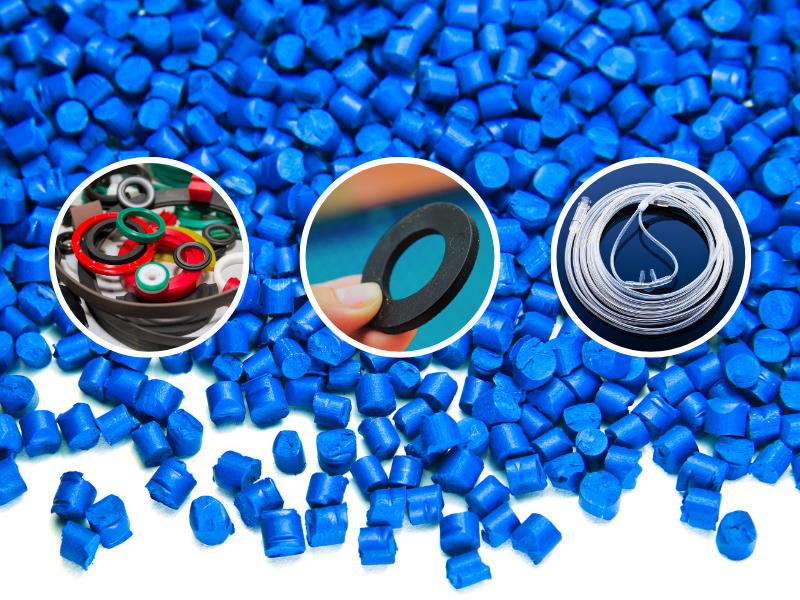
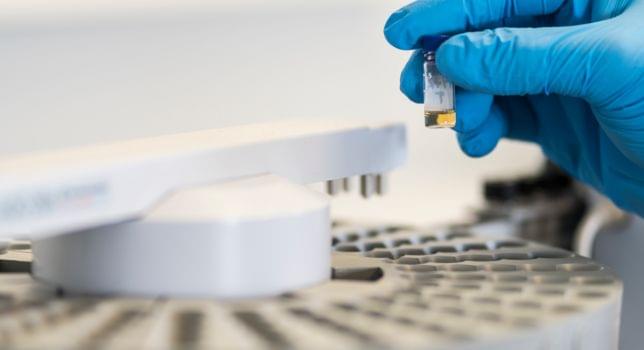
If you are working with a new material, changing supplier, investigating a material issue, or trying to understand more about the composition of a plastic or rubber product, GC-MS can help reduce unknowns.
Gas chromatography-mass spectrometry, or GC-MS, is an analytical technique used to separate, identify and quantify volatile and semi-volatile organic compounds. It can be used to analyse a wide range of liquid, solid and gaseous sample types, including plastic and elastomeric materials.
Smithers polymer experts use GC-MS to perform both targeted analysis and non-targeted screening of plastics, rubbers and related materials. This makes GC-MS a valuable tool for applications ranging from residual monomer testing and additive identification to the investigation of unknown contaminants or material failures.
When would you need GC-MS analysis?
GC-MS can provide useful insight when you need to understand more about a material, investigate a problem, or compare products and suppliers.
Common reasons for using GC-MS include:
- Introducing a new material or material supplier
- Gaining a better understanding of material composition
- Investigating contamination, odour, residues or unexpected compounds
- Comparing batches or suppliers
- Supporting failure analysis investigations
- Identifying additives, plasticisers, anti-degradants or other formulation components
- Testing for residual monomers, solvents or process-related chemicals
How does GC-MS work?
In GC-MS analysis, compounds from the sample are separated using gas chromatography, before being detected and identified using mass spectrometry.
The sample is introduced into the instrument and volatile or semi-volatile components are separated as they pass through a capillary column carried by an inert gas. The separated components then pass into the mass spectrometer, where they are ionised and fragmented.
The resulting mass spectra can be compared with reference libraries and known standards to support the identification of unknown compounds. Where required, GC-MS can also be used to quantify specific compounds, helping teams understand not only what is present, but at what level.
Expert interpretation is important, particularly when analysing complex polymer and elastomer samples where additives, degradation products, contaminants or processing residues may all be present.
How Smithers can help
Smithers provides
GC-MS analysis as part of broader chemical characterization and failure investigation support for plastics, rubbers and related materials.
Our experts use GC-MS to support:
- Characterization of rubbers and plastics
- Additive identification
- Reverse engineering of rubber products
- Residual monomer testing
- Residual solvent analysis
- Analysis of fuel samples
- Failure analysis
- Batch-to-batch comparison
- Process optimization
- Headspace analysis of volatile compounds
GC-MS data can help manufacturers, suppliers and product teams make more informed decisions about material selection, quality, formulation, supplier changes, contamination concerns and in-service performance.
Find out more about Smithers
chemical characterization support or contact our experts to discuss how
GC-MS analysis could support your materials challenge.
Related GC-MS Resources
Explore related Smithers resources on GC-MS and chemical characterization: