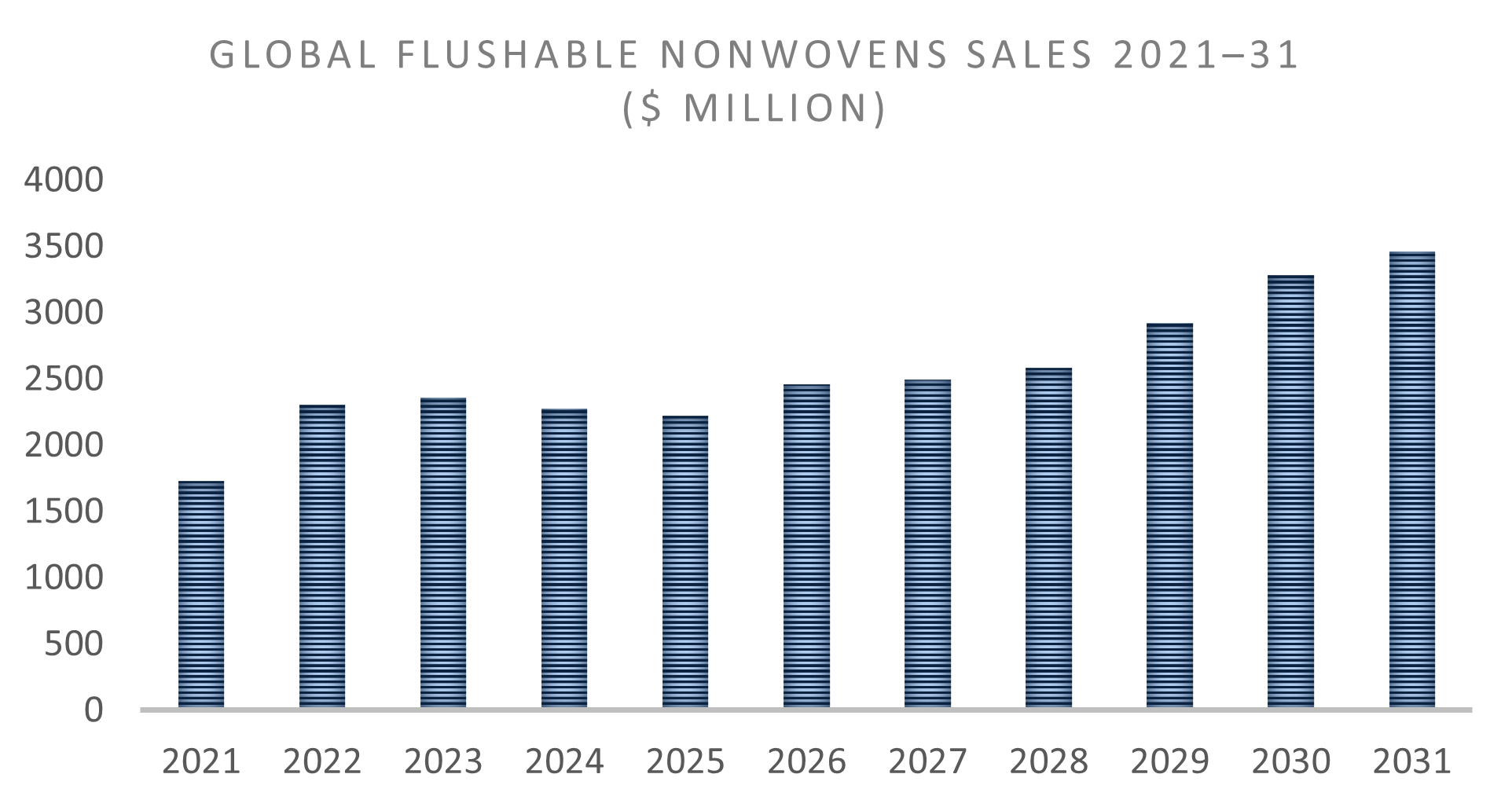
New research from Smithers, the global authority on nonwovens market intelligence, reveals that flushable nonwovens sales are growing at over 7% per year, driven by evolving regulations, emerging markets, and shifting consumer demand.
Data in its newly published report,
The Future of Flushable Nonwovens to 2031, finds that robust demand growth has not been sufficient to offset a structural oversupply that now defines the industry’s outlook through the end of the decade. Global capacity will reach 253,000 tonnes against demand of just 140,262 tonnes in 2026.
With volume demand growing at 8.2% compound annual growth rate (CAGR), the market will take approximately seven years to absorb 2026 capacity levels.
“The flushable nonwovens sector presents a compelling paradox,” said Phillip Mango, industry specialist and report author at Smithers. “Demand fundamentals are strong – particularly in North America and Asia – but producers are navigating aggressive export pricing from Turkey and China that is reshaping competitive dynamics across every major region.”
When the standard spunlace market became oversupplied, producers in Turkey and China pivoted to flushable spunlace, which at the time offered tighter supply and healthier margins. Approximately 50,000 tonnes of additional flushable capacity entered the market between 2022 and 2025. The resulting price collapse has placed European and North American producers under severe pressure, as they cannot compete at Chinese price levels while maintaining acceptable returns.
The report identifies markedly different growth stories across key regions. In Asia, affordable flushable products are entering the market for the first time, driving volume growth of at least 10% CAGR as penetration rates rise from a low base. In North America, consumer confidence and GDP growth have outperformed forecasts. Shoppers are not only buying flushable wipes but trading up to premium offerings. With penetration still below European levels, the market offers genuine runway for further expansion. Europe is the weakest major region, growing at just 5.5% CAGR, with producers largely reducing consumer prices to defend demand share.
Hydroentangled wetlaid production, which uses high-pressure water jets to entangle fibres, dominates installed capacity in 2026 and remains the most practical manufacturing route for flushable end products. Wood pulp and short-cut rayon/lyocell are the primary raw materials, balancing absorbency, structural integrity, and cost. Wood pulp provides low-cost, highly absorbent filler properties, while rayon and lyocell deliver the fibre length and tensile strength required for a product that must hold together in use, yet break down reliably after flushing.
The regulatory landscape is at an inflection point in 2026. Voluntary guidelines are giving way to mandatory government requirements. In the United States, the federal WIPPES Act requires prominent ‘Do Not Flush’ labelling on non-flushable wipes. In the European Union, Directive 2020/2151 mandates that wet wipes containing plastic carry a clear ‘do not flush’ label.
A universal definition of ‘flushable’ remains elusive, with INDA/EDANA’s GD4 standards and the IWSFG PAS standards continuing to coexist across regions. Convergence is expected, but a single accepted global standard is not anticipated before 2031.
FIGURE 1: Global flushable nonwovens sales, 2021-2031
 The Future of Flushable Nonwovens to 2031
 charts the rapid growth of flushable nonwovens with a detailed quantitative breakdown by process, material, end-use and geography. It examines the strategic challenges and opportunities facing nonwovens producers over the next five years, and provides guidance on navigating an increasingly complex and fragmented global regulatory environment. The report is available to purchase now from Smithers priced $6,750 (€6.350, £5,475).